Standard edition
HamsterOS
- CPU
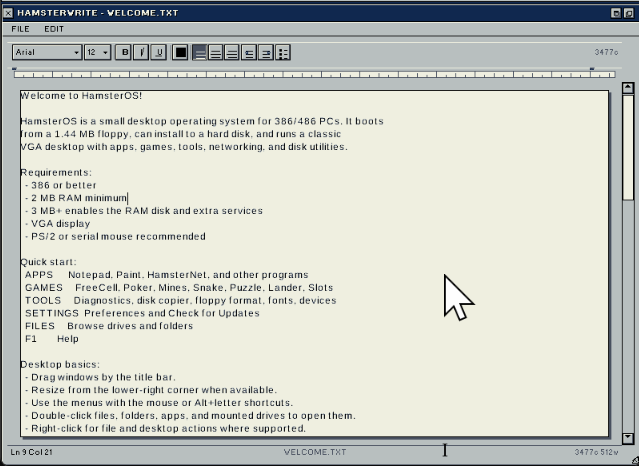
- 386 or newer
- Memory
- 2 MB or more
- Display
- VGA, 16 color
- Disk image
- 1.44 MB
- Included
- HamNet, HamChat, audio, games, tools, and hard-disk installer
386+ PCs · 2 MB+ RAM · 1.44 MB floppy · VGA 16 color · HamNet+
A tiny free desktop OS for old PCs that still want to do something useful.
HamsterOS is the free starting point: a self-booting graphical desktop with files, tools, games, networking, updates, and a hard-disk installer. Try it, test it, tell us what breaks, and help make classic computers feel lively again.
Want more details, see the technical information page.
 Running on a 386-class PC
Format
Bootable .img files in 1.44 MB, 720K, and 360K sizes.
See it first
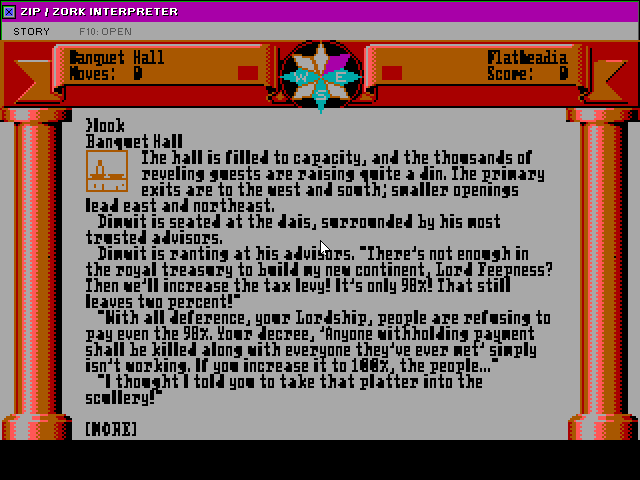
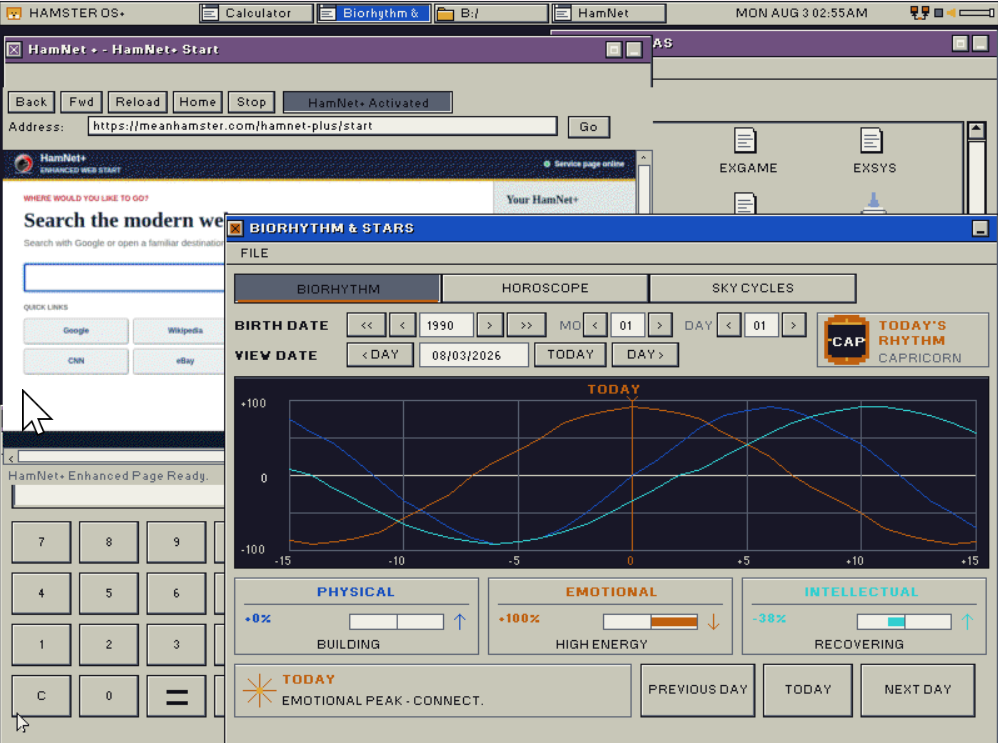
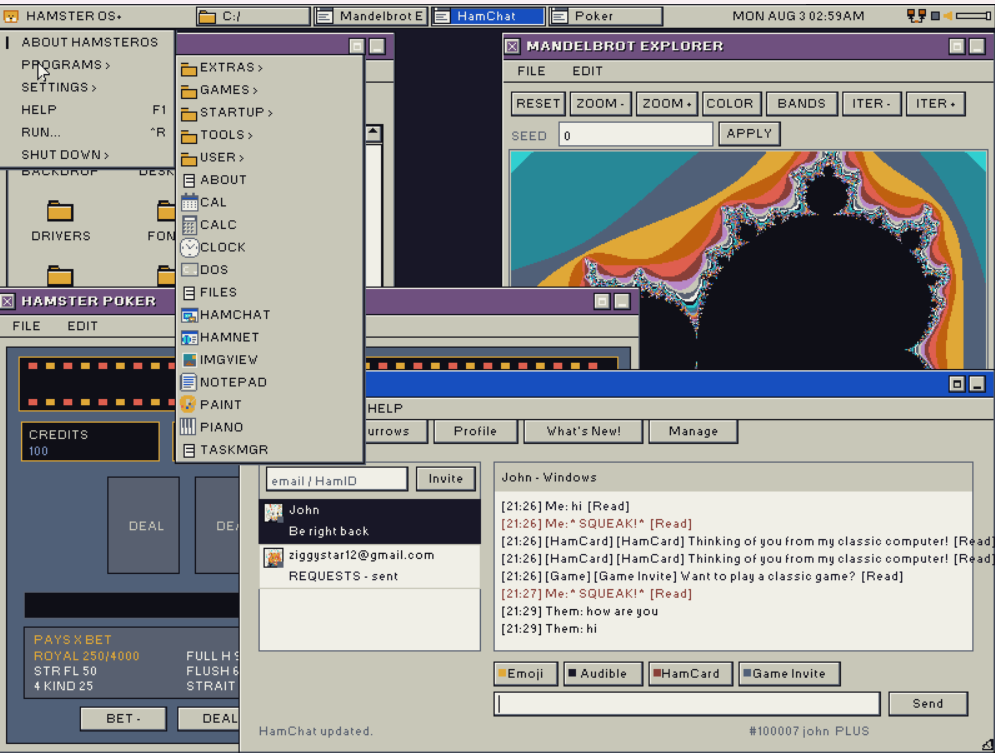
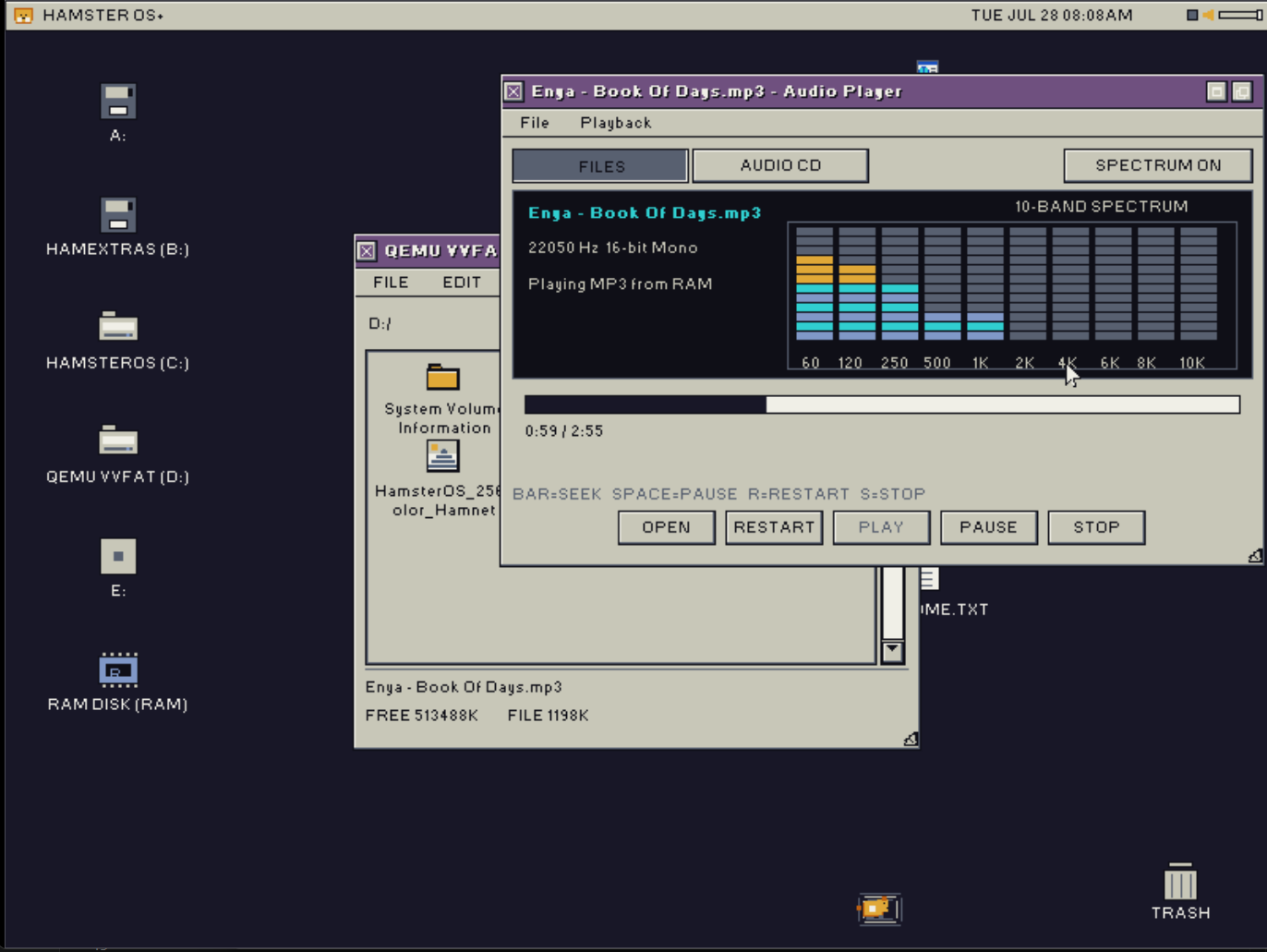
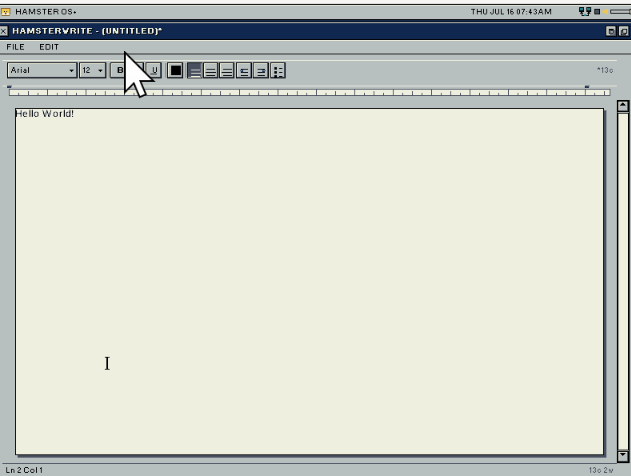
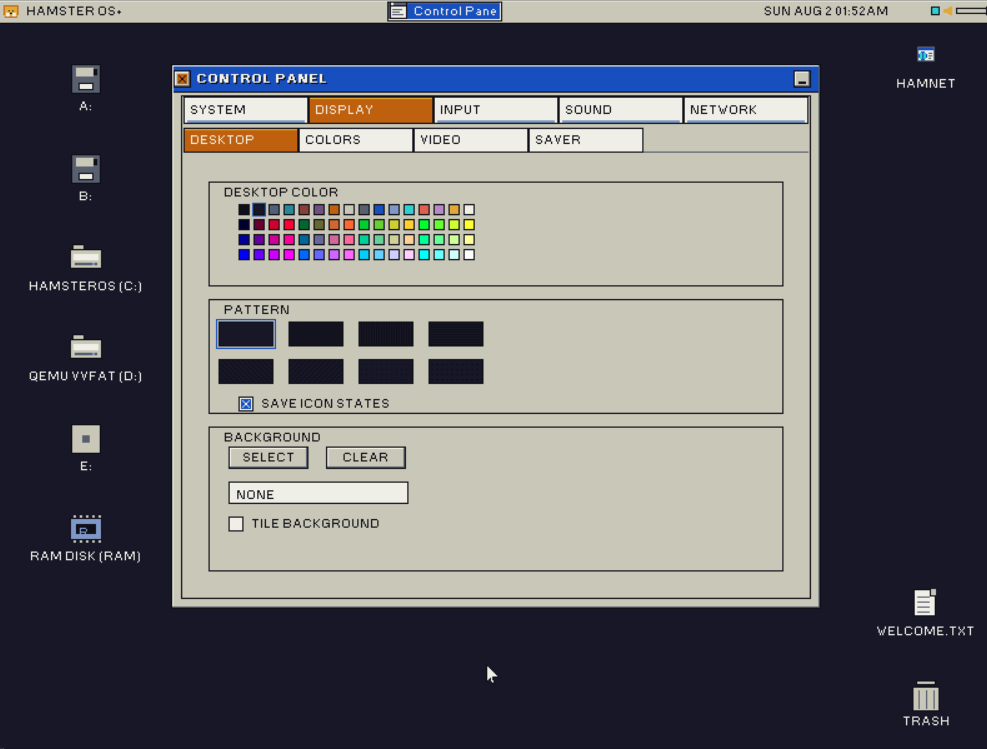
This is the actual desktop: browse the web, play music, write a document, and tune the system without leaving the 16-color interface.
Hardware support
Standard edition
8086/8088 edition
What is included
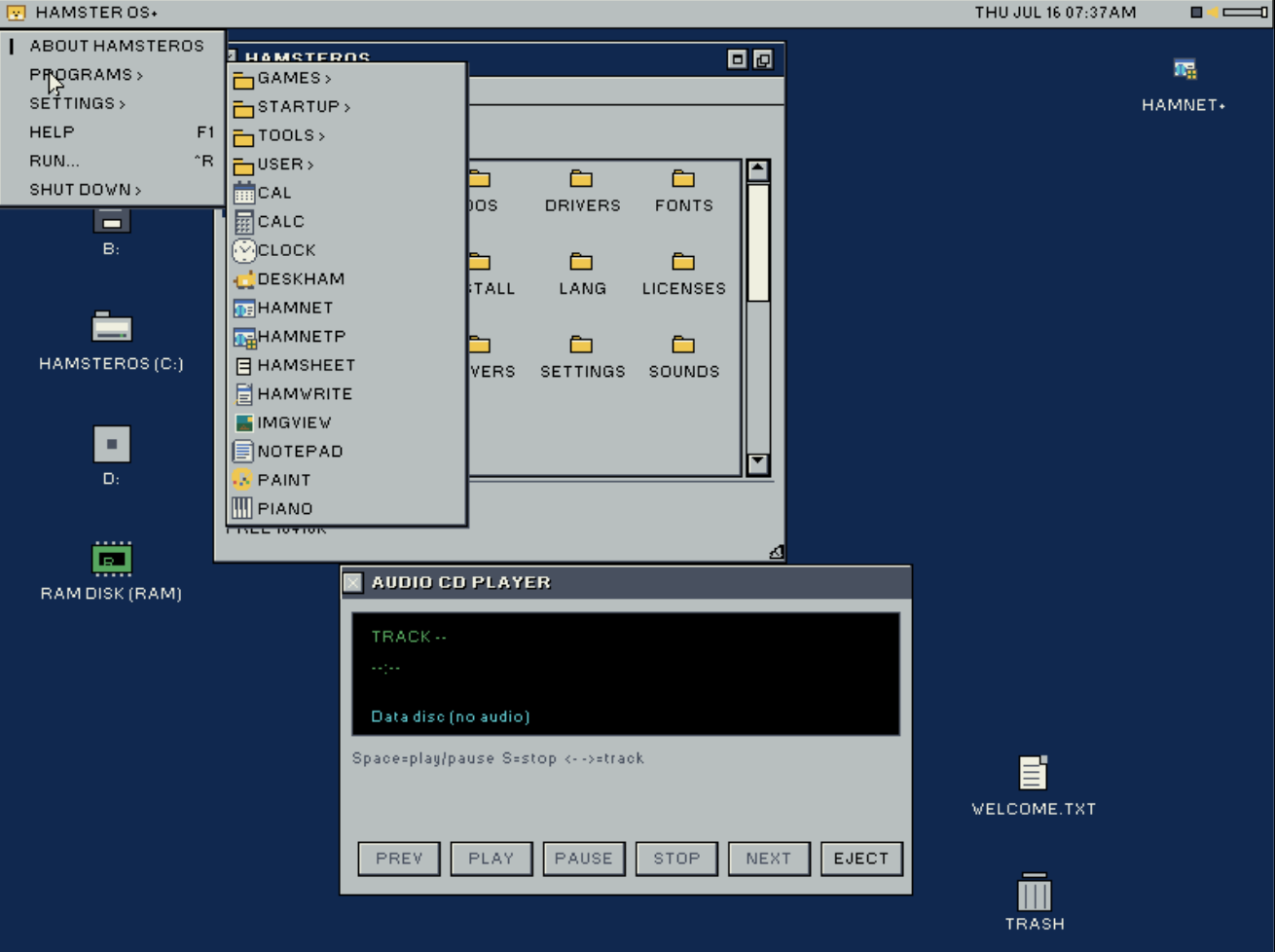
Desktop programs, networking, audio, games, and hardware support on one 1.44 MB disk image.
Boot a 32-bit graphical desktop from a free 1.44 MB image, with no hard disk required.
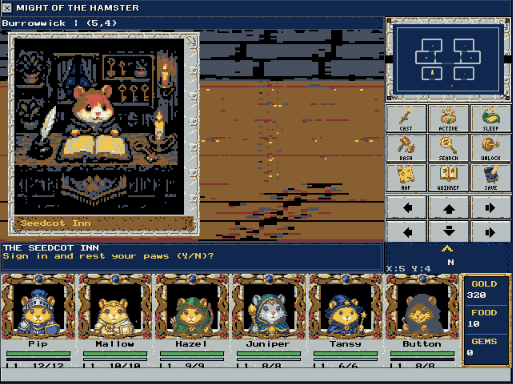
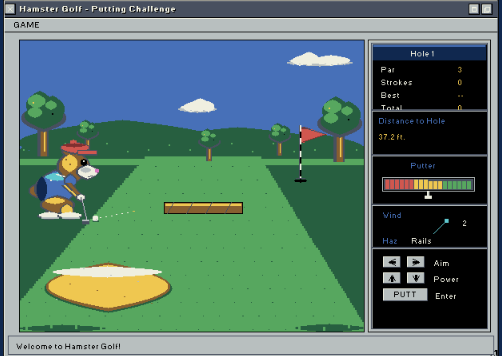
File Manager, Notepad, games, Long File Name support, hard-disk install, and updates are ready from the desktop.
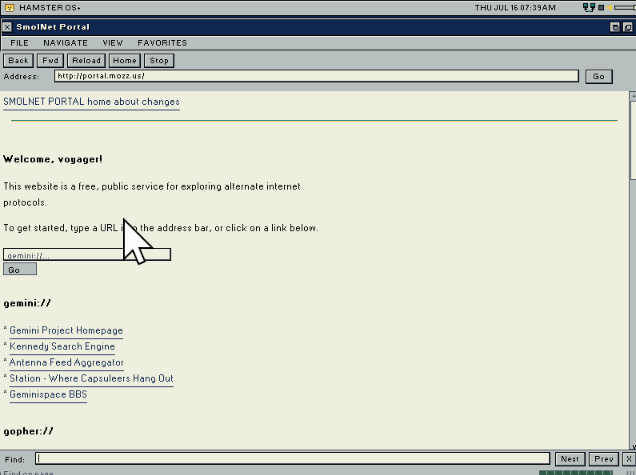
Browse HTTP, Gemini, and ProtoWeb with HamNet, or use HamNet+ for modern pages on a 486-class PC.
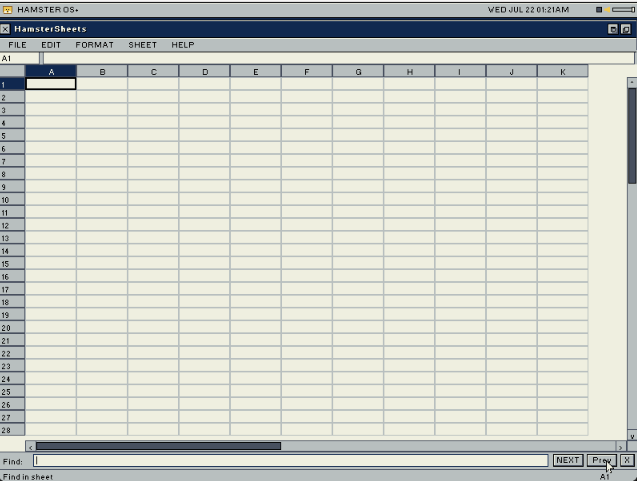
Add HamsterWrite, HamsterSheets, the full updater, extra games, fonts, templates, and savers.
SoundBlaster-class audio, ISA Ethernet, and PicoMEM/PicoMEM 2 sound and network features are supported.
Play MP3s, Audio CDs, WAV, MOD, and MIDI with controls and a 10-band spectrum view.
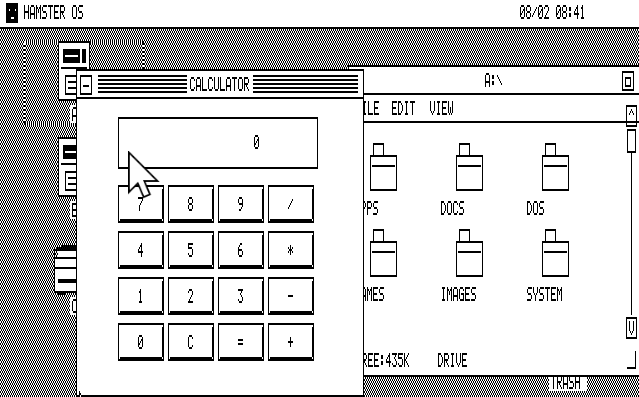
HamsterOS CGA
Free downloadHamsterOS CGA brings the HamsterOS graphical desktop to classic 8086, 8088, and V20 computers.
Hamster Extras
Buying Hamster Extras helps pay for real-hardware testing, drivers, and documentation. It also gives you the larger programs and games that do not fit on the free HamsterOS disk.
HCommand is a real-time strategy game with base building, resources, computer players, local-network games, and HamNet matchmaking.
Get Hamster Extras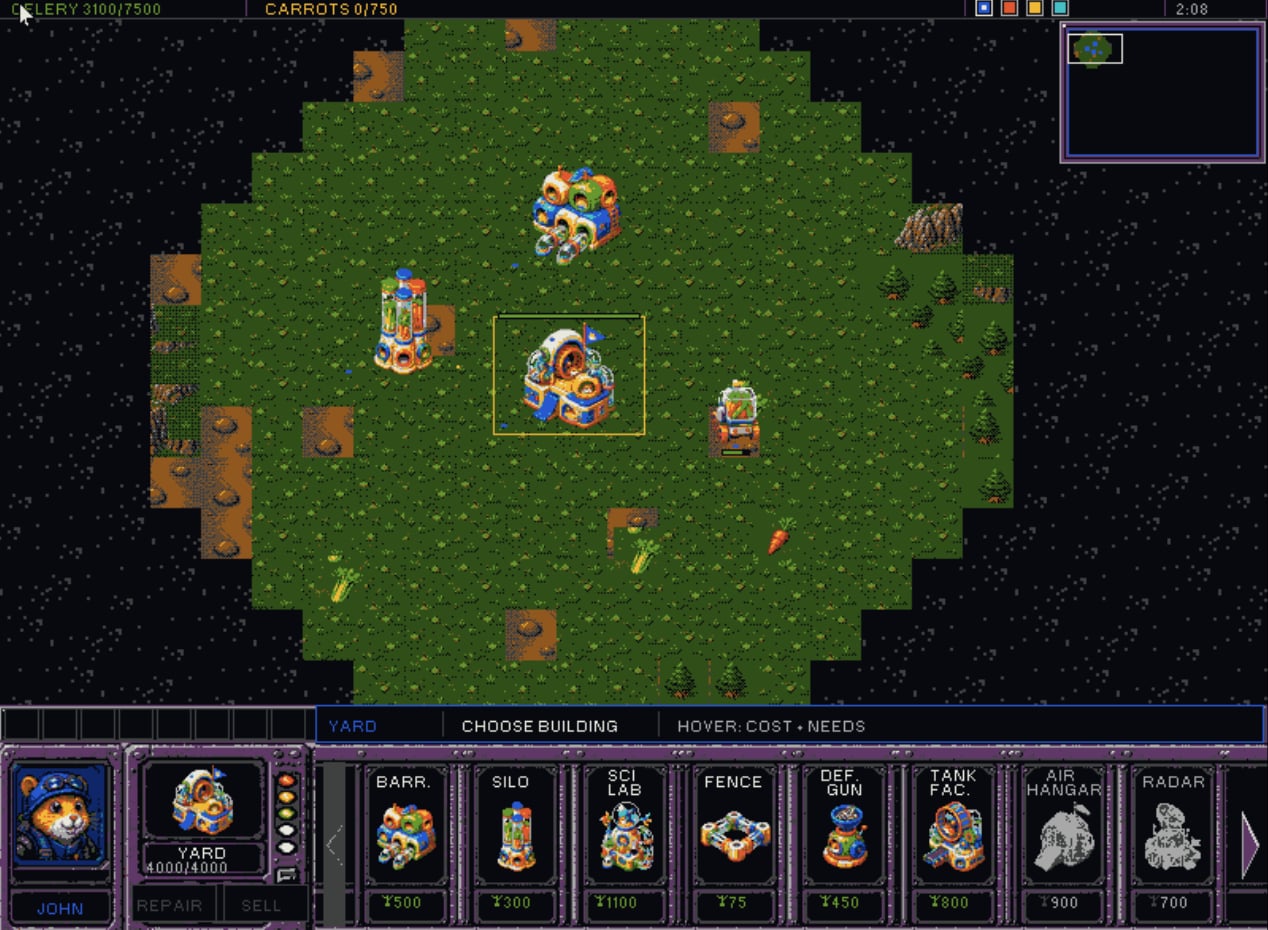
Hamster Command
HamNet and HamNet+
HamsterOS includes HamNet for classic plain HTTP and ProtoWeb browsing. The same app can activate the optional HamNet+ hosted service, which transforms modern public HTTPS pages into something a classic computer can handle. Extras is not required.
What changed in Beta 3
Applications and multitasking
External applications now load into protected memory and unload when they are closed. With 8 MB or more, several applications can stay open at once. A 2 MB system runs one at a time.
Video and hardware support
Beta 3 adds Cirrus 800x600x16, selectable VBE 256-color modes, and standard VGA support on IBM XGA-2 systems. PS/2 Model 77 and P75, PicoMEM, ATA, SCSI, and CD support have also been improved.
HamChat
HamChat now has 30 emoji, 12 audibles, rich messages, Burrows, and delivery and read receipts. It uses your free Mean Hamster account and does not require HamNet+.
Printing and office programs
Notepad and HamWrite can print text through LPT1. HamsterPaint and Image Viewer can print graphics. HamWrite and HamSheets now have undo and more complete editing.
Audio Player
The Audio Player supports MP3, WAV, VOC, PCM, MOD, and MIDI. MP3 playback uses adaptive buffering to help it keep up on classic hardware.
Installation and Hamster Extras
The Hamster Extras installer works from A: or B: and has been tested on a 2 MB system. Hard-drive upgrades, drive detection, and copying long filenames from CD have also been improved.
Usable beta
HamsterOS is available and usable today, but still in beta. Bug reports, hardware notes, and oddball test results are welcome. Extras purchases go back into development, compatibility, and real machine testing.
Technical information
Hardware lists, shortcuts, storage behavior, apps, games, audio, networking, and release notes are on the technical information page.
Read technical information →Press
Hackaday
Donald Papp covered the floppy desktop, built-in apps, hard-disk install path, DOS support, and HamsterWeazle.
Read the Hackaday feature →Tom's Hardware
Bruno Ferreira spotlighted HamsterOS as a 32-bit GUI operating system that fits on one 1.44 MB floppy.
Read the Tom's Hardware feature →